1. INTRODUCTION
In our world today, the objective of
any man, wherever the domain/career he works in, is to succeed. In this quest
for success, we then act according to what is known as the market requirements
so as to stay visible, proficient and efficient in today’s professional market
as a whole. But the main concern here will be the translation market/industry.
This said, the choice of this theme was not done haphazardly. In an era where
science and technology have taken over in every sphere of life and career
including translation, it is important, if not, essential that we evaluate what
role these technologies have in the process of productivity, output and
quality, as per the requirements needed in the actual translation market. One of these requirements would be the
mastery of computer-assisted translation (CAT) tools, an indispensable
element, skill and requirement every modern translator must possess. It is in
this vein that Samuelsson-Brown, states: Technology is developing at a
frightening pace and the demands made on the translator do not show any signs
of abating. In fact, the translator is becoming more and more dependent on men
formation technology and, if the translator does not adapt to change, he or she
may become uncompetitive.
Some of the techniques used in modern
translation technology can be traced back to the 9th century when an Arabic
cryptographer named Al-Kindi developed the method of
frequency analysis that is still used today. However, it wasn’t until the
mid-20th century, when computers became available and affordable, that
translation technology truly began to take shape.
Here’s an overview of the evolution of
translation technology (Sin-Wai, 2016):
1950s: Georgetown University and IBM
introduced the world’s first machine translation (MT) system. The approach was
rule-based and lexicographical, which means that it relied on pre-programmed
rules and dictionaries. Although this early form of MT proved unreliable and
slow, it was still revolutionary—a stepping stone on the path towards a more
advanced technology.
1970s: The United States Department of
Defense and Advanced Research Projects Agency (DARPA)
started developing speech recognition technologies that paved the way for
voice-to-text technologies.
1980s: The arrival of electronic
dictionaries and terminological databases during this decade was another major
turning point. These tools helped to make translation more accessible by
providing translators with instant access to information (terminology with its
translation) that could be used during the project.
Mid-1980s: The precursors of modern
translation management systems (TMS) entered the scene from the hand of
Coventry Lanchester Polytechnic University and its
ALP System.
Late 1980s – early 1990s: IBM
researchers introduced statistical machine translation (SMT). These systems
were word-based and trained to translate one language into another by comparing
large amounts of parallel texts in both languages (bilingual corpora). For
example, they would analyze how often the German
phrase “das auto” was translated as “the car” vs “the vehicle” vs “the
automobile”, and choose the most frequent translation for the text at hand.
Early 1990s: Most commercial
computer-assisted (or aided) translation (CAT) tools appeared during this
decade—a milestone that transformed translation technology forever. It enabled
a whole new generation of translators to work more efficiently and effectively.
Late 1990s: A new version of IBM’s
statistical translation engine, this time phrase-based instead of word-based,
was released. It became the commercial standard for years to come until Google
entered the fray in 2006 with their neural machine translation (NMT)
technology.
Early 2000s: The first cloud-based TMS
solutions appeared in the market, enabling translation teams to work more
flexibly and collaborate with other company members regardless of location.
2006: Google launched Google
Translate—still statistical—which took the world by storm. The system first
translated the input text into English before translating it into the target
language. The system used predictive algorithms, which would guess which words
should come next, based on the words and phrases it had “learned” before. These
guesses often resulted in poor grammatical accuracy.
2016: Google Translate introduced
neural machine translation (NMT), which outperformed phrase-based CAT tools and
became the new commercial standard.
Translation technologies have been
around for more than 50 years now, but as our world becomes increasingly
interconnected, it’s only grown more essential and having to master them is not
exempted.
In the Cameroonian context, the
translation market is very competitive. It will be of great importance for us
to know what the actors of this market think of translation technologies, its
role in professional insertion, and how they impact the translation process. In
other words, productivity.
1.1 Statement of the Problem
Just as translation has evolved over
the years, same has its market. Nowadays, translational skills alone do not
suffice to make you a successful translator. The presence of science and
technology is manifested by the proliferation of translation technology and its
related software which today are of a wide variety. One could then talk of an interdependence between translational and technological
skills. Therefore, mastering these skills is for every translator a
must-have weapon in his arsenal. Translators who do not possess this skill do
not last long in the industry, for these translation technologies now
shape/dictate the market and therefore all actors must align so as to sooth the
market requirements which are: churn out more content quickly and rapidly,
increase their accuracy, quality and overall effectiveness in order to remain
eligible, visible and proficient in the long run. The problem statement of this
study is therefore the fact that some translators who are willing to be part of
today’s beyond borders, wide and competitive market, neglect the role and
impact of these various translation technologies during the translation process, and equally undermine these technologies as the access
card to professional insertion.
1.2
Research Questions
1)
What is the impact of translation technologies during
the translation process?
2)
What is the role of translation technologies
in the professional insertion of translators?
3)
What is the the perception of stakeholders in
the translation industry about the use of translation technologies?
1.3
Objectives
1)
To
determine the impact of translation technologies during the translation
process.
2)
To determine the role of translation
technologies in the professional insertion of translators.
3)
To assess the opinion of translators on the use of the
translation technologies.
2.
LITERATURE REVIEW
The aim of this
chapter is to discuss the relevant literature regarding the domains of
translation technologies and translation market. The chapter successfully
examines the literature at three levels: the conceptual review, which goes
through all the relevant terms used in our work; the theoretical review, which provides
the theories that underpin the study and lastly, the empirical review, which
looks at past works relating to translation technologies and the translation
market.
2.1 Translation
Different scholars in the field
of translation defined it in so many ways depending on their view of the
process. According to Catford (1965:20) translation is defined as the
replacement of textual material in one language (SL) by equivalent textual
material in another language (TL). He insists on two key terms: textual
material and equivalent. Textual material means that in normal conditions it is
not the entirety of the SL that is replaced by the TL equivalent, only on the
level of lexis and grammar. As for equivalence, Catford shows it from the
linguistic angle and finally maintains that translation equivalence is ‘any TL
form (text or portion of text) which is observed to be the equivalent of a
given SL form (text or portion of text), and that portion of a TL text which is
changed when and only when a given portion of the SL text is changed’ (Catford,
1965:27-28).
Translation is
equally the communication of the meaning of a source-language text by means of
an equivalent target-language text. The English language draws a terminological
distinction (which does not exist in every language) between translating (a
written text) and interpreting (oral or signed communication between users of
different languages); under this distinction, translation can begin only after
the appearance of writing within a language community. Because of the laborious
nature of the translation process, since the 1940s efforts have been made, with
varying degrees of success, to automate translation or to mechanically aid the
human translator. More recently, the rise of the Internet has fostered a
world-wide market for translation services and has facilitated "language
localisation".
2.1.2 Computer-Assisted
Translation (CAT) tools
Exploring
various definitions of CAT tools is far from being easy since different
scholars gave them slightly different meanings. However, some definitions are
reviewed to avoid any confusion each time the term is mentioned throughout this
work.
To begin with,
Computer-Assisted Translation (CAT) tools should not be confused with MT since
the former does not seek to replace the translator by fully automating the
translation process. CAT tools are also different from HAMT because in the
latter, the human intervenes when the machine is stuck and the input needs to
be simplified and output requires improvement (Kenny, 1999:68). Apparently, the
role of CAT tools is to assist translators in their work without doing the job
for them or eliminating the human intervention from the process (Bowker,
2002:247).
Drawing on
various views held by different scholars, Computer-Assisted Translation (CAT)
tools have been referred to as various kinds of computer software used by
translation practitioners for professional translation. (Garcia, 2007; Garcia,
2012; Pym, 2011; Taravella & Villeneuve, 2013). Some scholars even include
both hardware and software products used by translators (Kenny: 1999:67).
Unfortunately, this definition may create confusion since many would be tempted
to add laptops, scanners, Word processors, spell, grammar and style checkers,
electronic dictionaries, which Bowker (2002) excluded from the list of CAT
tools because they are just part of the general knowledge.
Other
authors like Hutchins and Somers (1992) even refer to such types of translation
technologies as Machine-Aided Human Translation (MAHT) and maintain that it is
the process through which the translator has the ability of selecting and using
the tools ‘as required or desired’.
2.1.3 Translation
Memory (TM)
Pym, Perekrestenko and Starink
(2006:8) define Translation Memories (TM) as ‘programmes that create databases
of source-text and target-text segments in such a way that the paired segments
can be re-used’. Doherty (2016:950) who considers a translation memory (TM) as
the ‘core of CAT tools’ also establishes that a TM is a programme used by a
translator as databases to store a text alongside its original text for the
purpose of reusing these pairs in full or in part when the translator receives
an assignment with ‘similar linguistic composition.’
assignment with ‘similar linguistic composition.’
Linguists
often work with similar texts/phrases/segments in localization. The translation
memory continuously compares the text translators work on with the data in the
base. In case of a match, the system suggests the appropriate translation. There are two types of matching :
- Fuzzy matches. Fuzzy matches are suggestions from the
translation memory system where texts match approximately (in Lingohub, between 55% and 99% matches). They suit a
given text in terms of meaning and spelling. Translators benefit from
using fuzzy matches as a starting point to reduce the effort needed for
the final translation.
- Exact matches. As the phrase indicates, exact matches
suit the given text exactly (in Lingohub, 100%
matches). Exact matches are provided if the source texts of a past and
future translation match completely. Thus, you can apply such exact
matches without further changes.
Translation Memories are keepers of text quality and foster high-quality
translations. Translators will translate matching phrases identically to ensure
textual and vocal uniformity. They maintain linguistic consistency across past
and future translations even if various translators work on your localization
projects.
According
to Langewis (2002 as quoted by Zafra,
2006), the terminology management system can be described a programme that
catalogues words and phrases as well as other relevant information (e.g.
grammatical, context, etc.) in a database in a way that will allow retrieval in
linguistic applications.
Robust
translation technologies are must-have tools for multinational businesses
serving a multilingual consumer base. A terminology management system is just
one of those: you can store, manage, and access the key source terms and
translations that describe your products and services — whether they are the
approved terminology or the rejected.
Here are
just some of the top characteristics of terminology management systems that
make them beloved by the world’s best global companies.
1. Consistency
Let’s
place a critical switch on your product that controls one of its key functions.
Imagine the confusion then that could result from every department of your
company using different terminology to describe that same product part. The
marketing team is calling it a thingamajig on the website sales page, the
technical writers are calling it a doodad in the user manual, and the engineers
placed doohickey on the label above the switch on the
product itself. (By the way, those are all actual generic terms for the same
thing: a whatchamacallit.)
The beauty
of a terminology management system is that it helps your content creators — in
whatever department they may be working in — understand that a common termbase is both right for product users and for the translation
teams that would otherwise carry that confusion forward into the target
language materials.
Confusion
is one aspect, but extra costs another. Inconsistency in the terminology used
decreases your potential re-use or leverage you could otherwise get from
existing translations. Also, by and large, productivity of
translations is up if
translators can quickly and easily access approved terminology.
Many
terminology management applications provide features to ensure that the
consistency is maintained by making it possible to insert definitions, show
proper usage, or otherwise share instructions that are specific to clients,
products, and more.
2.
Centralization
Of course,
content creators, translators, and diverse internal departments have been used to operating in
their silos —
contributing to the inconsistency issue described above. Another benefit to
terminology management is, therefore, that these diverse stakeholders can —
with user rights/approvals — contribute to, connect with, and share the
resources of a single, central terminology base.
When you
are working with multiple translation teams, you recognize that centralization
of terminology is your means of standardizing terminology usage (see 5 Things to Know
About Creating a Multilingual Glossary [Cliff Notes]). Unsurprisingly, this contributes to cost
and time efficiencies: no more time wasted in determining whether a term is
approved for use or not and no costly error corrections to documents where
outdated terminology had been used or where one translation team used a term
different from another team’s choice.
3.
Automation
Afraid
that building a terminology database will be a painstaking, hair-pulling chore?
Well don’t be! Thanks to automation features in terminology management systems,
building a reliable termbase starts with your legacy materials. You do not start from scratch: you import
your previously translated materials along with their source-language
documents.
From your
already developed resources you can — relatively painlessly — extract, search,
index, group, and categorize terminology for use in new projects or, more
generally, as an integrated part of translation management workflows that
include glossaries, translation memories, and style guides.
In a
similar vein, automation can help analyse the existing source language content
and using frequency analysis identify repetitive source terms for potential
inclusion in your termbase. When used with bilingual
data, the same functionality may suggest potential candidate translations for
any new terms.
4.
Integration
The beauty
of having your multilingual terminology in order comes from the ability of your
terminology management system to maximize its value by integrating with other
essential tools that are part of today’s translation workflows.
For
instance, automatic checkers will verify the consistency of the terminology
used in your translations with your termbase, and
produce a report that can be used to easily pinpoint potential errors upfront.
Similarly, your terminology system should allow for a smooth integration with
your translation
management system or your authoring tools.
5. Roles
and Workflows
Having a
large team of translators or editors accessing your termbase
is great, but without some sound functionality that allows you to assign
appropriate roles to individual users, things can easily fall into disarray. It
should account for various roles such as content creators, those who can query,
suggest, validate or update specific terminology, those who can provide context
or definitions, import or export glossaries, as well as the wide range of
potential users on the client as well as the LSP side.
Having a
sound system of user roles is then essential for creating standardized
workflows that account for individual scenarios, such as:
- Terminology validation process for new
terms identified by content creators or customers
- Terminology validation process for new
terms identified by translators during the translation process
- Process for managing terminology
changes, including managed changes to approved legacy terms
Last but
not least, your terminology management system should support the two
terminology-related ISO standards used — ISO 10241 (Terminological entries in standards) and ISO 704 (Terminology work - Principles and methods).
6.
Metadata
Terms as
such are effectively useless without context. So a good terminology management
system should provide for an easy way of managing specific metadata that go
with each term. These metadata — such as status, source, product, project,
domain, date of entry, history and dates of changes as well as users — are
critical for translators or terminology approvers. They enable them to
understand the context and history of individual terms so they can make
informed decisions about their use and to perform advanced termbase
management operations.
7.
Standards Support
Your
terminology management system should not work in isolation. Terminology should
easily flow in and out of your termbase as needed.
For that, look to support for standards such as Term Base eXchange (TBX), the ISO-approved, open XML-based standard
for exchanging structured terminological data. Further down the road, look for
new exciting developments such as the potential
interoperability with the XLIFF 2.0 Glossary Module (via TBX).
8.
Future-Proofing
Let’s say
that your company has
grown from 10
products localized into 2 languages to 25 products localized into 15. Now
imagine the amount of content that you would have to create for them all.
Today’s
terminology management systems can grow with the content produced for your
different needs. Moreover, the best systems help you track that content in
whatever format it may be displayed in — whether for content headed to the
print shop or content headed to your website.
As
maintained by Slocum (1988:5), human-aided machine translation is viewed as ‘a
system wherein the computer is responsible for producing the translation per
se, but may interact with a human monitor at many stages along the way’.
The name
itself suggests that a greater percentage of the work is done by the machine,
but there is human involvement during the process, in an interactive mode, or
at the stage of preparation of the text or the stage of the output. Besides,
Doherty (2016) acknowledged that without human intervention, MT is deprived of
quality:
Despite
the widespread and diverse adoption of MT in research and practice, most
machine translated content still requires some form of human intervention to
edit the MT output to the desired level of quality and/or to verify its quality
before publication, dissemination, product release, legal compliance, and so on
(Doherty, 2016:958).
The two
last stages of human intervention are respectively referred to by
Hutchins
& Somers (1992:150) as the ‘pre-editing’ and ‘post-editing’ stages:
This stage mostly
includes the checking of the source texts to eliminate anything that might
cause a problem to the machine. Names (proper nouns) and embedded clauses are
identified, homographs are marked, unknown words are substituted, and so on.
The human being reformulates the text using a ‘controlled language’ as
mentioned by Hutchins & Somers (1992:151).
Vauquois & Boilet
(1985:30) also state that:
Pre-editing is the insertion of some
conventional marks in the input text, which is not otherwise modified, by
replacing words with "synonyms" or by rewriting parts to change the
syntactical structure. When pre-editing is used, the inserted marks refer to some
lexical ambiguity (for example, ambiguity between noun and verb), or indicate
the scope of a coordination, the antecedent of a relative pronoun, etc.
At this stage, the output from the
Machine Translation system is correct to reach an acceptable standard. Vauquois & Boitet (1985:30)
equally maintain that ‘post-editing is necessary in all cases where high
quality of the output must be attained, as opposed to situations where
information gathering is the main purpose.’ Slight modification may be made in
case the person who needs the text only wants it for an information purpose. On
the contrary, thorough modifications are made if the text is meant for publication
and distribution. Here, the human being plays the role of an editor. Every
error has to be spotted and lexical and structural changes made by retyping
without expecting any help from the system. (Hutchins & Somers, 1992:152)
In Human-Aided Machine Translation
(HAMT), the source text has to be modified before, during or after its
translation by the computer. The human being intervenes and changes the form of
the input before the translation process starts to make it easier to process by
the computer or they introduce some additional information into the source text
to facilitate further analysis by the computer. Kozłowski
(2002 as quoted by Puchała-Ladzińska,
2016:93) noticed that those systems are not very popular among the users, as
the users need to manually answer the questions asked by the computer and thus
do not have the full control over the output.
Sager
(1994 as quoted by Quah, 2006:13) describes Machine-Aided Human Translation
(MAHT) as the use of computer software by translators ‘to perform part of the
process of translation’.
According
to Sager (1994 as quoted by Quah, 2006:8), Machine Translation (MT) originally
referred only to automatic systems with no human involvement. By adding a
slight precision, Hedblom (2010:1) defines it as a
sub-genre in Artificial Intelligence that deals with automatic translations
between different languages. In the same vein, the European Association for
Machine Translation (EAMT) considers MT as ‘the application of computers to the
task of translating texts from one natural language to another.’ As for the
International Association of Machine Translation (IAMT), MT is defined as
taking ‘input in the form of full sentences at a time [sic] and generating
corresponding full sentences (not necessarily of good quality)’ (Hutchins,
2000).
2.1.8 Technological
Skills that a Translator Must Acquire
Nowadays, the
translation process does not only rely upon translators’ linguistic competences.
It also requires the mastery of information processing skills and a few special
IT skills. In other words, and quoting Susanne J. Jetak
and Gary Massey, “[t]his is apparent from the very first stages of the
translation process, when communication between the translator and the client,
and the processing of the source text, will in most cases be effected
electronically.” These skills could be categorised into;
To begin with,
translators need advanced knowledge of word processing software. A few years
ago, it was enough to have some knowledge of Microsoft Word, Excel, and
PowerPoint. However, nowadays, any translator must acquit themselves with
software for desktop publishing, conversion of speech to text, quality assurance,
among others. These skills are becoming increasingly necessary to achieve a
successful career.
Secondly,
computer-assisted translation tools play an important part in the translation
process. They help translators increase their daily output, as well as
consistency and quality. Moreover, they assist translators in managing their
time and resources more effectively. CAT tools are not the same as machine
translation, though.
In the third place,
the ability to touch-type and type fast will save translators a lot of time and
increase their productivity. Besides, having to look down at the keyboard means
a higher chance of back and neck pain. However, those translators who are not
great at keyboarding always have the option of using speech-to-text software.
Certain knowledge of
programming is essential for translators specialised in IT, gaming, and other
areas involving coding. In the case of translators who provide website
translation services, being able to work with WordPress can come in handy, as
many clients want their translations done directly on their websites. Moreover,
a significant percentage of websites all over the world use WordPress.
In the words of PhD
Celia Rico Perez, “[p]roject management is about
coordination, teamwork, planning, and control techniques; (…) it has lately
gained a name in the translation profession due, mainly, to market growth and
virtual teams. When translation is subcontracted to teams communicating through
the Internet, (…) project management offers essential tools for translation
providers.”
There is so much
variation in the texts that translators work with that many of them end up
having to pick up specialised vocabulary quickly. In this sense, figuring out
how to find out what they do not know becomes essential. It is important to
consider that developing good research skills takes practice because it
involves learning how to find useful, relevant, and trustworthy information
online.
2.1.9 The
Cameroonian Translation Market
Kengne in his research
paper Mutations in The Translation Industry: Exploring Cameroonian
Professional Agents’ Strategical Quest for Sustainability identifies from
the profiles in the Cameroonian Translation subsystem, that it appears that the
greatest majority of the respondents provide translation services on the global
market and depend very less on the local demand. Precisely, 89.7% of
Cameroon-based agents (Freelancers, Public service/freelance translators,
Translation companies) are assumed to be in touch with the decentralised market
and held to remain competitive to ensure themselves sustainability. These
agents are also the primary representatives of the Cameroonian translation
industry, with regard to the interconnection between the centres and the
peripheries of the global industry. In this position, the 89.7% of agents from
the Cameroonian market reported that the mutating features of the translation
industry has been a major bone to pick with, considering that, as agents within
the last-ranked peripheral market, their professional environment does not always
favour professional emancipation.
Ideally, to keep up
with the evolving trend of the industry, these agents are expected to have a
great attention to changing practices in the global industry, so as to keep
themselves in line with the best practices of the profession at any time. At
this point it becomes interesting to learn that unlike what would be expected,
the overall trend of these agents’ concern for update on mutations is not very
high. While 38.3% percent report to be highly concerned with updating
themselves on evolving practices, 50% confess having just average interest on
keeping themselves abreast on evolution trends in the global market. Most
alarming, over 11% reportedly have low or no interest in getting informed on
translation mutations.
In this same vein, it was further
observed that, once mutations are identified and industry’s best practices are
known, these agents’ primary concern is not oriented towards complying with
such best practices, in order to counter the adverse effects of these
mutations.
2.2
Theoretical Review
Theoretical
considerations are as important in translation as they are in other fields of
study. Translation theory is therefore, the body of knowledge that is used to
determine the appropriate methods for the widest possible range of texts or
text categories. It provides a framework of principles, restricted rules and
hints for translating texts. It therefore serves as a background for problem
solving.
The sociolinguistic
theory deals primarily with language as it is used by society in communicating.
Ngoran (2017) posits that
unlike the linguistic and philological theories of translation, sociolinguistic
theories of translation are target-text oriented and give priority to the receptors
of the translation. They use the communication model and view translation as a
communicative act in which a message encoded in the source language has to be
decoded by the receptors of the translation. They posit that for decoding to
take place, the message in the source text has to be interpreted, taking into
consideration the extra- linguistic context of the text when it concerns
certain expressions. For a text to be properly interpreted, information
relating to its author, its historical background, the circumstances involved
in its production and the history of its interpretation is required.
The modern version of the
sociolinguistic theories of translation may be seen in Newmark's (1988)
communicative approach to translation, where what matters is the effective
conveyance of a message within a specific context. This is equally what the
pragmatic approach to translation advocates the view of translation as the
transfer of a message from one language to another within a specific context.
Here we see the relevance of Popovik's (1970) idea of
'shifts of expression' when a message moves from one language to another, hence
the constrained latitude of the literary translator to stylistically create in
the receptor text. This theory permits the contextualization of
translation, translation technologies and the translation market to Cameroon.
2.2.2 The Communication Theory
The
Communication Theory of Translation is a theory that aims at communicative
translation, “which attempts to produce on its readers an effect as close as
possible to that obtained on the readers of the original” (Newmark, 1988: 39),
Newmark (idem) further explains that communicative translation, which is target
culture, target text and target- reader-oriented, “addresses itself solely to
the target reader, who does not anticipate difficulties and would expect a
generous transfer of foreign elements into his own culture as well as his
language where necessary”. Ngoran (2017) states that
the communication theory of translation posits that a translation should sound
as natural as possible in the target language and should be such that the
target reader will not doubt its originality. It should therefore read as an
original composition in the target language and not at all as a translation.
This
theory is important to our study because the whole aim of having to master
translation technologies supersedes just to have a successful career but rather
foster and simplify communication between different cultures.
2.2.3 The Skopos Theory
The skopos theory is a theory that stands out against the claim
that there is no aim or objective as the translator embarks on the translation
process. Ngoran (2017) states that Skopos is a Greek term which means “aim” or “purpose”. Skopos theory as introduced in translation theory in the
1970s by Hans J. Vermeer as a technical term referring to the purpose of a
translation and of the action of translation:
The nature
of the target text is “primarily determined by its skopos
or commission” (Vermeer 1989/2000: 230) and adequacy as the measure of
translational action. In Reiss and Vermeer (1984: 139), adequacy describes the
relations between the source text and the target text as a consequence of
observing a skopos during the translation process. In
other words, if the target text fulfils the skopos
outlined by the commission, it is functionally and communicatively adequate
(Munday, 2001: 80).
Ngoran (2017) cited in Vermeer and Reiss (1984:119)
give the main tenets of the Skops theory entitled Grundlegung einer Allgemeine Translations Theories (Groundwork for a General
Theory of Translation). These are:
1. A translation (or
target text) is determined by its skopos.
2. A target text is
an offer of information in a target culture and target language concerning an
offer of information in a source culture and Source language.
3. A target text does
not initiate an offer of information in a clearly reversible way.
4. A target text must
be internally coherent.
5. A target text must
be coherent with the source text. 6. The five rules above stand in hierarchical
order, with the skopos rule predominating.
Although one
of the criticisms levelled by Nord (1997: 109-122). This theory is essential in
our study in that it enables us to identify the purpose of acquiring
technological skills. The general aim of acquiring these skills is to better
set translation purposes such as meeting up with market and client demands.
This section reviews
previous empirical works regarding the domains of technology and translation.
Ristikartano (2015) in The Role of
Translation Technologies and Human Resources in International Business
Communication. The objective of the thesis was firstly to define the role of
technological and human resources in the command of languages in international
business communication in a sample of British, Finnish and Russian SME companies.
The second objective was to develop guidelines for the application of both
technological and human resources in the said sector of communication in order
to make their business more advanced on the global market. Quantitative
research applied to get statistics for stated research questions. A survey
study approach formed the research strategy. The survey created via an online
questionnaire form measured similarities and differences regarding the use of
technologies and human resources in international business communication in the
sample mentioned above. The cohort of 30 companies was divided into three
groups according to their geographical location. The survey deepened the
understanding of the role of language related technological advances and human
resources including language competencies in communication and made it possible
to create a concept of Language Management Strategy. To clarify the idea of
applying LMS to a company on the field, individual LMS guidelines are developed
for KSK Ltd.
Doherty (2016), in
The Impact of Translation Technologies on the Process and Product of
Translation firstly proved how technological advances have led to
unprecedented changes in translation as a means of interlingual communication.
This article discusses the impact of two major technological developments of
contemporary translation: computer-assisted translation tools and machine
translation. These technologies have increased productivity and quality in
translation, supported international communication, and demonstrated the
growing need for innovative technological solutions to the age-old problem of
the language barrier. However, these tools also represent significant
challenges and uncertainties for the translation profession and the industry.
In highlighting the need for increased awareness and technological
competencies, I propose that these challenges can be overcome and translation
technologies will become even more integral in interlingual communication.
Based on
Schumpeter’s theory of innovation and from the perspective of creative
destruction (2019), the study proposes the concepts of “positive transformation
outcomes” and “negative transformation outcomes” of machine translation
technology on traditional language service providers. On the one hand, many high-tech
companies enter into the language service industry by taking the advantage of
machine translation technology, bringing competitive pressure on traditional
language service providers, which is considered as “negative transformation
outcomes”. On the other hand, traditional language service providers themselves
can improve translation efficiency, reduce costs and expand business line by
adopting the advanced machine translation technology, which is considered as
“positive transformation outcomes”. The study then collects data from the real
language service providers and empirically evaluates the net impact of machine
translation technology on the performance of language service providers. The
case study based on the business revenue data and the development trend
information of two famous language service providers demonstrates that the
language service provider that adopts the advanced machine translation
technology could significantly increase the business revenue and promote
positive development, while the language service provider that avoid the new
technology could result in the business revenue decline and development
stagnation. The results indicate to some extend that currently the positive
impact of the “positive transformation outcomes” from machine translation
technology have already exceeded the negative impact of the “negative
transformation outcomes” lead by machine translation technology. The role of
machine translation technology should be paid more attention, especially within
language service providers.
Terratranslations (2022) in The Role of
Technology in the Translation Industry examine how technology has impacted
the translation industry. Technology has its faults—there’s no doubt about
that—but in the translation industry it has been an enabler for progress. As
long as all parties involved in the process understand that technology has its
limitations, it can be used to do more, better, and work faster. In a world
where access to information in a language everybody understands has become
critical, having technology on our side is an enormous help.
3. METHODOLOGY
This
chapter discusses the research design, area of study, population, sample of
population, sampling technique, instrument for data collection, validation of
questionnaire and administration of the instrument as well as the method used
for data analysis.
3.1 Research
Design
In
general, a research design allows to have control over the study. Before
deciding on which research design to adopt, the researcher assesses various
factors including the purpose of the research, participants and time allocated
to the study.
This study
is a survey which aims at outlining the role of technological skills for a
successful career in the translation industry. In order to do this, a quantitative
research design was adopted via the distribution of questionnaires to all the
respondents.
3.2 Data
Collection Procedure/Tools
Within the
framework of this research, a questionnaire entitled ‘The Role of Technological
Skills for a Successful Career in the Translation Industry’ was designed on the
online platform Google Form. In order to collect data, the said questionnaires
were administered to 75 professional translators in Cameroon. These
questionnaires were administered to the respondents via email and WhatsApp
within a period of one month.
3.3 Data Presentation and Analysis
This section
presents, analyses and interprets the results. The data analysis aims at
answering the research questions that have been mentioned in chapter one of
this research. Then, analysis was done using a descriptive and inferential
statistics method called the Pearson Chi-squared test. The analysis focused
mainly on establishing a correlation between the perceived effect of age of
translators on the use of CAT tools, and the effect of computer skills on the
use of CAT tools.
3.3.1 The role of CAT tools and their impact
in the translation process
In order
to determine the role of CAT tools and its impact, questionnaires were shared to
translators so as to evaluate how relevant these tools are to them on the basis
of suitability, speed and consistency. These are three very important elements
in today’s translation industry.
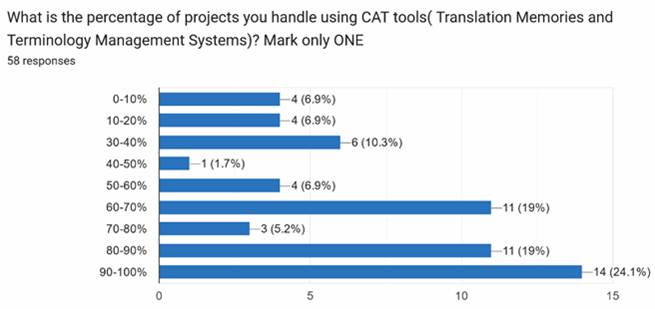
According to the figure
above the majority (69%) strongly agrees that CAT tools are responsible for
handling 50-100% of their translation projects. While 24.1% account for the fact
that these CAT tools handle a little or no percentage of their projects. This
in itself proves that most translators perceive CAT tools and its use as
indispensable.
4. CONCLUSION
In this study on the role of technological skills in a
successful career in the translation industry, various advantages of these
technologies have been discussed such as speed and efficiency while
investigating how translators in Cameroon perceive CAT tools, and how these
tools are important for their professional insertion. A series of terms,
concepts, theories and other articles were reviewed (translation, computer-assisted
translation tools, terminology management systems, sociolinguistic theory, skopos theory and communication theory etc).
Data was collected via questionnaires which were designed
on google form. They were distributed to the respondents via email and
WhatsApp. The collected data was analysed using the
Pearson’s Chi-squared test.
After presentation of the findings, it was realised that the first objective is attained because the
crucial utility of CAT tools in the translation process was revealed. So is the
second objective. It equally confirmed that CAT tools are essential for the
professional insertion of translators. As for the third objective, the study
was able to prove that most translators view CAT tools as indispensable
. Therefore, each translator should be aware of these technologies.
Amin,
M.E. (2005). Social science research conception, methodology and analysis.
Kampala, Uganda: Makerere University Press.
Archer,
J. (2002). Internationalisation, technology and translation. perspectives:
Studies in Translatology, 10(2), 87–117.
Arnold,
D., Balkan, L., Meijer, S., Humphreys, R. L. & Sadler, L. (1994). Machine
translation: An introduction guide. Manchester, England: NCC Blackwell Ltd.
Arthern, P. (1979). Machine
translation and computerized terminology systems: A translator’s viewpoint. In
B.M. Snell, (ed.), Translating and the Computer. Proceedings of a Seminar
(pp. 77-108). Amsterdam, Netherlands: North-Holland Publishing Company.
Austermühl, F. (2001). Electronic
tools for translators. Manchester, England: St Jerome Publishing.
Baker,
M. (Ed.). (2001). Routledge encyclopedia of translation studies. London, England: Routledge.
Beesley, K. R. (1986). Machine-assisted
translation with a human face. Data Processing, 28(5), 251-257.
Bowker,
L. & Fisher, D. (2010). Computer-Aided translation. In Y. Gambier
& L. V. Doorslaer (Eds.), Handbook of
Translation Studies, 1 (pp. 60-65). Amsterdam, Netherlands: John Benjamins.
Bowker,
L. & Pearson, J. (2002). Working with Specialised Language: A Practical
Guide to Using Corpora. New York, USA: Routledge.
Bowker,
L. (2002). Computer-aided translation technology. Ottawa, Canada: University of Ottawa Press.
Bowker,
L. (2005). Productivity & quality: A pilot study on the impact of translation memory systems. Localisation
Focus, 4(1), 13-20.
Catford,
J.C. (1965). A linguistic theory of translation: an Essay on Applied
Linguistics. London, England: Oxford University Press.
Christensen,
T.P. & Schjoldager, A. (2010). Translation-Memory
(TM) research: What do we know and how do we know it? Hermes, 44, 89-101.
Christensen,
T.P. & Schjoldager, A. (2016). Computer-aided
translation tools – the uptake and use by Danish translation service providers.
The Journal of Specialised Translation, 25, 89–105.
Cocci,
L. (2009). CAT Tools for Beginners. Journal of Translation Journal,
13(4).
Cohen,
L., Manion, L. & Morrison, K. (Eds.). (2000). Research
Methods in Education (5th Ed).
London, England: Routledge Falmer.
Contemporary approaches and emergent traditions
(pp.327345). Amsterdam, Netherlands: Elsevier Science Publishers B.V.
Cost/Benefit
Analysis. (Master’s dissertation, Monterey Institute of International Studies,
Monterey, California). Retrieved from https://www.scribd.com/document/280395579/ADVANTAGESAND-DISADVANTAGES-OF-TRANSLATION-MEMORYpdf.
Diewert, W.E. (2004, July
28-29). Theories of productivity growth and the role of government in facilitating
productivity growth. Paper presented at the Eleventh Conference of the
Institute of Translation and Interpreting. London, England. Retrieved from
https://www.researchgate.net/publication/228877345_Theories_of_productivity_growth_and_the_role_of_government_in_facilitating_productivity_growth
Dillman, D.A. (2007). Mail
and internet surveys: The Tailored Design Method – 2007 Update
with New Internet, Visual, and Mixed- Mode Guide. Hoboken, New Jersey, USA:
John Wiley & Sons.
Dillon,
S., & Fraser, J. (2006). Translators and TM: An Investigation of
Translators' Perceptions of Translation Memory Adoption. Machine
Translation, 20(2), 67-79. Retrieved from http://www.jstor.org/stable/20461509
Doherty,
S. (2016). The impact of translation technologies on the process and product of translation.
International Journal of Communication, 10, 947–969.
Durban,
C., Martin, T., Mossop, B., Schwartz, R. & Searls-Ridge,
C. (2003). Translator training and
the real world: Concrete Solutions for Bridging the Gap – Roundtable Part
A, Translation Journal 7 (1). Retrieved July 6, 2017, from
http://translationjournal.net/journal/23roundtablea.htm
Englund-D.
B. (2005). Expertise and explication in the process. Amsterdam, Netherlands: John Benjamins Publishing Company.
Esselink, B. (1998). A
Practical guide to software localization. Amsterdam, Netherlands: John Benjamins
Publishing Company. European association for machine translation. (n.d.). What
is machine translation? retrieved from http://www.eamt.org/mt.php
Federico,
M., Cattelan, A. & Trombetti,
M. (2012). Measuring user productivity in machine translation enhanced
computer assisted translation. paper presented at the
tenth conference of the association for machine translation in the Americas
(AMTA), San Diego, CA. Retrieved from
http://www.mt-archive.info/AMTA-2012-Federico.pdf
Fernández-Parra,
M. (2016). Integrating computer-assisted translation tools into language
learning. In A. Pareja-Lora, C. Calle-Martínez, & P. Rodríguez- Arancón (Eds), New perspectives on teaching and working with languages
in the digital Era (pp. 385-396).
Dublin: Research-publishing.net.
http://dx.doi.org/10.14705/rpnet.2016. tislid2014.450
Fiederer, R. & O’Brien,
S. (2009). Quality and machine translation: A realistic objective? The Journal of Specialised
Translation, 11, 52–74.
Freeman,
R. (2008). Labour productivity indicators: Comparison of two OECD databases
productivity differentials & the Balassa Samuelson Effect. Paris,
France: Organisation for Economic Cooperation and Development.
Fulford,
H. & Zafra, J G. (2005). Translation and
technology: a study of UK freelance translators. The Journal
of Specialised Translation (4), 2-17.
Fulford,
H. (2001). Translation tools: An exploratory study of their adoption by UK
Freelance Translators. Machine Translation, 16(4), 219232.
Galliers, R. (1991). Choosing
appropriate information systems research approaches: A revised taxonomy. In
H.E. Nissen, H.K. Klein & R. Hirschheim (Ed.),
Information Systems Research:
Garcia,
I. (2007). Power-shifts in web-based translation memory. Machine Translation
21, 55–68.
Garcia,
I. (2012). Machines, translations and memories: Language transfer in the web
browser. Perspectives Studies of Translatology,
20(4), 451–461.
Gouadec, D. (2007). Translation
as a profession. Amsterdam, Netherlands:
John Benjamins Publishing Company.
Gracia, I. (2009). Beyond
translation memory: computers and the professional Translator. The journal
of specialised translation, 19, 199-214.
Guerberof, A. (2009). Productivity
and quality in MT post-editing. Paper presented at the Twelfth Machine
Translation Summit (MT Summit XII), Beyond Translation Memories: New Tools for
Translators Workshop. International Association for Machine Translation.
Guerberof, A. (2012). Productivity
and quality in the post-editing of outputs from translation memories and
machine translation. (Doctoral dissertation, Universitat
Rovira i Virgili,
Tarragona, Spain). Retrieved from
https://www.researchgate.net/publication/320467281_Productivity_and_quality_in_the_postediting_of_outputs_from_translation_memories_and_machine_translation
Ha,
L. A., Fernandez, G., Mitkov, R. & Corpas, P.G. (2008, May 26 - June 1). Mutual bilingual
terminology extraction. Proceedings of the International Conference on Language
Resources and Evaluation, LREC 2008. Marrakech, Morocco.
Hedblom, M. (2010). Machine
translation – A Rosetta stone for the 21th century? Hutchins, J. (1997, May
8-10). Translation Technology and the Translator. Paper presented at the
Eleventh Conference of the Institute of Translation and Interpreting. London,
England.
Hutchins,
J. (2000). The IAMT certification initiative and defining translation system categories. Paper presented
at EAMT workshop,
Hutchins,
J. (2003). Machine translation: general overview. In R. Mitkov (Ed.), The Oxford Handbook of Computational
Linguistics (1st ed., pp. 501-511). New York, USA: Oxford University Press,
Inc.
Hutchins,
J. (2010). Machine translation: A concise history. Journal of
translation studies, 13(1-2), 29– 70.
Hutchins,
W.J. & Somers, H. L. (1992). An introduction to machine translation.
Johnson,
P. (1992). Human computer interaction: Psychology, task analysis and
software engineering. Maidenhead: McGraw-Hill.
Kenny,
D. (2011). Electronic tools and resources for translators. In Malmkjær, K. &
Windle, K. The Oxford Handbook of Translation Studies (pp. 455–472). Oxford:
Oxford University Press.
Knowles,
M. S. (1973). The adult learner: A neglected species. Houston,
Texas: Gulf Publishing.
Knowles,
M. S. (1980). The modern practice of adult education: From pedagogy to
andragogy. Englewood Cliffs, New Jersey: Cambridge Adult Education.
Knowles,
M. S., Holton III, E. F., Swanson, R. A., Swanson, R., & Robinson, P. A.
(2020). The Adult Learner: The Definitive Classic in Adult Education and
Human Resource Development. New York: Taylor & Francis.
Knowles,
M.S. (1984). Andragogy in Action. San Francisco: Jossey-Bass
Lagoudaki, E. (2006). Translation
memories survey 2006. User’s perceptions around TM use. Translation and
the Computer, 28, 1-29. Retrieved from http://mt-archive.info/Aslib-2006-Lagoudaki.pdf
Lange,
C. A. & Bennett, W. S. (2000). Combining machine translation with
translation memory at Baan. In Sprung, R. C. (Ed) (2000). Translating
into success: cutting-edge strategies for going multilingual in a global age
(pp. 203-218). Amsterdam, Netherlands: John Benjamins
Publishing Company.
Läubli, S., Fishel, M., Massey, G., Ehrensberger-Dow,
M. & Volk, M. (2013). Assessing post-editing efficiency in a realistic
translation environment. In S. O’Brien, M. Simard & L. Specia (Eds.), Proceedings of MT Summit XIV Workshop on
Post-editing Technology and Practice (pp. 83–91). Accessed on July 2, 2018
from http://www.mt-archive.info/10/MTS-2013-W4-Laubli.pdf Ljubljana, May 2000. Retrieved from http://ourworld.compuserve.com/homepages/WJHutchins/IAMT
cert.htm London: Academic Press.
Mankiw,
G. N. (1998). Principles of economics. Fort Worth, Texas: Dryden Press.
Melby,
A. K. (1996). Should I use machine translation? Utah, USA: Brigham Young
University.
Miles,
M. B. & Huberman, A. M. (1994). Qualitative data analysis: An expanded
sourcebook. California, USA: Sage Publications, Inc.
Moorkens, J. (2012). Measuring
consistency in translation memories: A Mixed‐Methods Case Study. (Doctoral
dissertation, Dublin City University, Dublin, Ireland).
Newmark,
P. (1982, 2001). Approaches to translation. Shanghai: Shanghai Foreign
Language Education Press. Retrieved from
https://www.scribd.com/doc/200791952/Peter-NewmarkApproaches-to-Translation
Newmark,
P. (1988, 2001). A textbook of translation. Shanghai, China: Shanghai Foreign Language Education Press.
Nida, E. A. & Taber, C. R.
(1982). The
Theory and Practice of Translation. Leiden, Netherlands: E. J. Brill.
Nida,
E. A. (1976). A framework for the analysis and evaluation of theories of
translation. In Richard W. Brislin (Ed.),
Translation: Applications and research. New York, USA: Gardner Press.
Nworgu, B. G. (1991). Educational
research: Basic issues and methodology.
Ibadan, Nigeria: Wisdom Publishers Ltd.
O’Brien,
S. (2012). Translation as human-computer interaction. Translation
Spaces, 1 (1), 101-122.
Puchała-Ladzińska, K.
(2016). Machine translation: A Threat or an Opportunity for Human
Translators? Studia Anglica
Resoviensia, 93(13), 89- 98.
Pym,
A. (2010). Translation and text transfer: An essay on the principles of
cross-cultural communication. Berlin, Germany: Peter Lang.
Pym,
A. (2011). What technology does to translating. Translation and Interpreting, 3(1), 1-9.
Pym,
A., Perekrestenko, A. & Starink,
B. (2006). Translation Technology and its Teaching. Tarragona, Spain: Servei de Publicacions.
Quah,
C. K. (2006). Translation and technology. Basingstoke, England: Palgrave Macmillan.
Sager,
J.C. (1994). Language engineering and translation: Consequences of
automation. Amsterdam, Netherlands: John Benjamins.
Sakwe, G.M. (2015). The
standard profile of the 21st century translator: Implications for translator training.
International journal of English language & translation studies, 3(3), 86-104.
Retrieved from http://www.eltsjournal.org
Samuelsson-Brown,
G. (2004). A practical guide for translators. Clevedon, Philadelphia:
Multilingual Matters.
Schäffner, C. (2000). Translation
in the global village. Clevedon, Philadelphia: Multilingual Matters.
Screen,
B. (2017). Productivity and quality when editing machine translation and
translation memory outputs: an empirical analysis of English to Welsh
translation. Studia Celtica
Posnaniensia, 2 (1), 119-142.
Serpil,
H., Durmuşoğlu-Köse, G., Erbek, M. & Öztürk, Y. (2016,
May 11-13). Employing
computer-assisted translation tools to achieve terminology standardization in
institutional translation: Making a case for higher education. Paper
presented at the International Conference; Meaning in Translation: Illusion of
Precision, MTIP2016, Eskişehir, Turkey.
Retrieved from https://ac.elscdn.com/S1877042816311855/1-s2.0-S1877042816311855main.pdf?_tid=c88e8f83-ed0e-4fbd 853ba79648ec65d8&acdnat=1539330850_abc8076ba5d9aa389ac9fe
1f9a6d31dd
Slocum,
J. (1988). Machine translation systems. Cambridge, England: Cambridge University Press.
Somers,
H. (Ed.). (2003). Computers and translation: A translator’s guide. Amsterdam, Netherlands: John Benjamins Publishing Company.
Taravella, A. & Villeneuve, A. O. (2013). Acknowledging the
needs of computer- assisted translation tools users: the human perspective in human-machine
translation. The Journal of Specialised Translation, 19, 62-74.
http://www.academia.edu/Documents/in/computer_assisted_Translation_tools
Vauquois, B. & Boilet, C. (1985). Automated translation at grenoble university. Computational Linguistics, 11(1),
28-36.
Warriner,
D. (2015). Rethinking productivity for independent translators. Circuit, 126. Accessed on July 1, 2018, at
http://www.circuitmagazine.org/dossier- 126/rethinkingproductivity-for-independent-translators
Webb, L. E. (2000). Advantages and Disadvantages of Translation Memory: a