This study traces the importance of moving the informal sector to a
professional level and its application in developmental efforts in Cameroon.
It is an attempt to highlight the important role of the informal sector in
development. It employs, Interactionist, structuralist
and social action theories to examine the relationship between the actors in
the informal sector and their contributions to development in Cameroon in
particular and the world at large. It adopted the mixed method approaches in
its design and employed in-depth interviews, questionnaires, focus group
discussions, observation as well as hard and electronic documents in
sourcing data. Quantitative data were entered using EpiData
3.0 and analysed with the support of SPSS 21.0.
They were described using frequencies, proportions and Multiple-Responses
Analysis while hypotheses were tested using Binary Logistic Regression
Modelling in assessing the overall effect of conceptual components and that
of individual predictive indicators. As for qualitative data, they were analysed through thematic analysis whereby ideas and
viewpoints were grouped under umbrella terms to reduce the abstraction of
data. The findings revealed that lack of education financial resources were
the main reasons why the informal sector could not effectively contribute to
development. There is need to further educate actors in the informal sector
in some pertinent areas that will equip them with the tools necessary for
effective development. It is recommended in this study that, the government
should take steps in mainstreaming participatory vocational training centres in different regions of the country to train
actors of the informal sector to better manage their resources. This will go
a long way to close the gap between the formal and the informal sector and
provide platforms for participatory management, empowerment and capacity
building and improve participation in development processes.
Accepted:22/02/2024
Published: 10/03/2024
*Corresponding
Author
SeavenKindeh
E-mail: kindesil@yahoo.ca/ seavenkindeh@gmail.com
Keywords: Informal
Sector, Socioeconomic development, Professionalization, Vocational training
centres
.
INTRODUCTION
The government of Cameroon has earmarked its emergence
by 2035. The economy to a large extent depends on the informal sector, which is
characterized by disorder. In a country where more
than 70 percent of the workers are in the informal economy, there is need for
more organization and control to draw the best from this sector of activity.
The socio-economic status of the informal
sector is very important in social science research as it plays a very
significant role in planning and carrying out development programmes.
The socioeconomic status of the actors in the informal sector may be affected
by various indicators like education, occupation, social class, income, wealth,
material fulfillment, and so on. Information on the socio-economic status of
informal sector is more than important to know how better this sector can
contribute to the fulfillment of the society and by that token, the fulfillment
of actors in this sector themselves. The informal sector provides livelihood
opportunities to a substantial section of the workforce in Cameroon. As the
employment situation in the formal sector is limited, it is the informal sector
which acts as a bailout for the vast pool of unemployed workforce. Though the
informal sector is the main source of livelihood, it is worth mentioning that
workers in this sector are usually at a disadvantaged position in relation to
the formal sector workers in terms of working conditions, earnings and consequently
their living conditions.
The term informal sector was first coined by Keith
Hart in 1973. The informal sector is one portion of the economy, which is not
taxed, not monitored, and not acknowledged by the government and as well, not
fully considered in the Gross National Product (GNP) and Gross Domestic Product
(GDP) of a country (Becker, 2004). It is also known as informal economy, shadow
economy or grey economy. Employment in the informal sector canbecategorizedasa)Self-employed,i.e.,
own-accountworkers,b) Wageworkers, i.e., employeesofinformalbusiness,and(c)Employers,i.e. owners andowneroperatorsof informalenterprises (Becker, 2004). However, according
to World Bank, the informal business comprise of two types of labour market activities.First oneisthecopingstrategies,whicharecasualjobs,temporaryjobs,unpaidjobs,subsistence agriculture,
andmultiple jobholding. Theotheroneisthe
unofficialearning strategieswhich aretax evasion, avoidance of labour
regulationandothergovernmentorinstitutional regulations, no
registrationofthecompany and also underground activities: crime, corruption activities
not registered by the government. Thus, informal business activities generally
considered as a labour-intensive small scale business
operation which requires lower capital and less skills.
For decades, it was assumed by economists that the right mix of economic
policies will wipe out the traditional informal activities as the modern formal
sector will grow and require more labour. However,
many countries could not create a good labour market,
hence informal business is still a major part of employment
(ILO, 2013).
The informal economy
is largely characterised by: Low entry requirements
in terms of capital and professional qualifications. A small scale of
operations. Skills often acquired outside of formal education. Labour-intensive methods of production and adapted
technology. The informal economy does not comprise the reproductive or care
economy, comprised of unpaid domestic work and care activities. Traditionally,
the informal economy was perceived as comprising mainly survivalist activities.
Various negative aspects were used to describe the informal economy ranging
from undeclaredlabour, tax
evasion, unregulated enterprises, illegal and criminal activity. Nevertheless,
the vast majority of informal sector activities provide goods and services whose
production and distribution are perfectly legal. In addition, informal economy
activities are not necessarily performed with the deliberate intention of
evading the payment of taxes or social security contributions, or infringing labour legislation or other regulations. The informal
economy can however include restricted illegal and restricted legal operations
or legal and irregular operators, but no criminal operators. The informal
economy should therefore not be confused with the criminal economy.
Professionalization
Professions have always been a subject of sociological interest (Abbott
1988; Freidson 2001). Professions are privileged,
autonomous occupational groups; they have gained control of specific,
socially relevant sections of work. A profession can define
professional education and controls the entry to a market. Typical professions
are doctors and lawyers; they developed in the late middle Ages. Professions
that established after doctors and lawyers are, for example, architects,
accountants, and engineers. Today, the focus is less on professions than on
professionalism as a specific mode of
work (Freidson 2001). There have been attempts to define
sequences of professionalization, the most influential being Wilensky (1964) who understood professionalization as the
sequence of seven steps: (1) a job becomes a full-time occupation; (2)
establishing a training school; (3) establishing a university program; (4)
founding a local professional association; (5) funding a national professional
association; (6) creation of a state license; (7) creation of a code of ethics.
We do not know whether professionalization will succeed in a particular field of work;
however, resuming research on professions and occupational change, we can
describe some phenomena linked to professionalization, specific tasks
which involve a high degree of uncertainty and require specialised
knowledge; (ii) a socially central value involved in these tasks, for instance
health or nature; (iii) a growing body of academic knowledge; (iv) a national
professional association or an equivalent disciplinary organisation.
Professionalization is a social process by which any trade or occupation
transforms itself into the ‘profession of the highest integrity and competent’.
Socioeconomic
development
Socio-economic development is a process that seeks to
identify both the social and the economic needs within a community, and seeks
to create strategies that will address those needs in ways that are practical
and in the best interests of the community over a long period of time. The
general idea is to find ways to improve the standard of living within the area
while making sure the local economy is healthy and capable of sustaining the
population present in the area. Socio-economic development occurs in neighbourhoods in metropolitan areas, sections of smaller
cities and towns, and even in rural settings. Jeffrey et al. (1999).
Socio-Economic
Importance of Informal Sector
Caroline O.N. Moser (1984: 135), notes that since the informal sector
concept was first introduced into academic anthropology by Keith Hart (1973)
and then popularized by the International Labour
Office, studies attempting to define it, describe it, and analyse
it have been so numerous as to constitute what she calls a "growth
industry."In general, the ILO's
interest in the informal sector concerned its capacity to absorb surplus labour and thereby ameliorate some of the most negative
conditions of urban poverty. Various studies have sought to determine further
whether or not the informal sector absorbed surplus labour
in a devolutionary manner without increase in productive output, or if it
contained autonomous dynamism for growth and, if so, how growth might best be
stimulated by government policy.In
either case, based on her extensive reviews of the literature, Moser (1978;
1984) was driven to conclude that the informal sector remains an exceedingly
fuzzy concept. Studies of it have embraced such an astonishing heterogeneity of
economic activity that it is virtually impossible to draw firm conclusions from
their comparison.In fact, such studies
appear to have contributed more to the debate surrounding the dualist and
non-dualist conceptions of the economy than they have contributed to the
empirical resolution of questions concerning economic institutions, the
organization of firms, enterprises, labour markets,
the economic strategies of workers, or the economic and social inequalities
attaching to any or all of these. Moser’s contribution to the informal is
different from the socioeconomic benefits in that this research brings out the
importance of creating vocational training centres to
help train those from the informal sector so they could improve in their
lifestyles.
Demographic
considerations
The literature is replete with other influences,
especially those of a socio-economic and demographic nature, that influence
participation in the informal sector. It has been argued that informal activity
tends to thrive in sectors of the economy that are characterized by labour-intensive, low-skilled and low-wage jobs and also
where it is easy to employ and pay workers without registration or
documentation (Djankov et al. 2003).Empirical evidence indicates that informal
work in most developing countries is concentrated in the distribution sector,
with a relatively low prevalence in certain sectors, such as the manufacturing
sector.
Christian (1994)
finds that individuals with higher incomes have a higher propensity to evade
taxes, and this encourages an increase in the informal activity. The sex of a
person appears to play an important role in the informal sector: most empirical
studies establish that males tend, more than women, to sell their labour services in the informal sector. While women, more
than men, are likely to be clients of the informal sector (Schneider et al.
2001).6 Small-business owners may show similar patterns. Depending on the
institutional structures in place, age can have varying influence on whether an
individual will participate in the informal sector: some studies have found
that age and informal sector activity are related, although there is no
definite pattern emerging.
In countries where
the social security (e.g. pension) is inadequate, retired persons are more
prone to enter the informal sector to supplement or maintain income levels (Portes et al 1986).Other variables likely to affect informal sector participation include
marital status (Anderson 1998, Schneider et al 2001), the number of dependents
of the agent (Gerxhani 2002, Smith 1987, Schneider et
al 2001), the area of residence of the agent (Portes
and Sassen-Koob 1987), and level of education.
The
Informal Sector in Cameroon
The Cameroonian literature on informal employment is moving away from a
traditional view of informality as evidence for labour
market segmentation.
According to the Cameroon
National Institute of Statistics (CNIS) (2005), “the informal
sector/employment in Cameroon means one person businesses without a tax
identification number and/or without any formal accounting system”. Cameroon
certainly shares with the other developing countries a lot of common features
in informal patterns.
In 2005 Cameroon’s
wood industry contributed about 6 percent to GDP. That same year, the wood and
wood processing industry accounted for 170,000 jobs, 150,000 in the informal
sector and 20,000 in the formal sector. Because startup costs are relatively
low, many illegal and unregistered small enterprises are in operation. They
mostly employ unskilled workers such as artisans and carpenters. The laws of
1999 paved the way for second-stage transformation in the country’s value
chain. (MINEFOF 2012).
Vocational training is not closelylinked to the needs of the labormarket. Vocational
institutions enroll a smallnumber of students and
focus on a few sectorssuch
as construction (about 25 percent of enrolment) whileleaving out other important areas of the economy,
such as tourism (3 percent
of enrolment) and agriculture (lessthan 1 percent). Apprenticeships,
whichcouldbe an efficient way to deliver training alignedwith the needs of privateemployers, canonlyoccurinformallybecausethereis no legalframework for privatecompanies to partnerwith training centers. As a result, mostyouth
do not seem to receiveanyprofessional training (especially in the Northernregions). And whenthey do, they tend to getit on the job (with the exception of the South-West region).
Young people
expressed concern about Cameroon’s economic situation. There are not enough
jobs available and this is the main reason for their unemployment (World Bank
Report 2015).
With the exception of
PIAASI, the informal sector has not been the object of any explicit program despite
its importance as a job provider. The Government seems to have preferred
handling this sector through programs covering issues closely related to it
rather than dealing heads on with the constraints faced by this sector.
Furthermore, efforts seem to have been focused on ways to lure operators away
from the informal sector and attract them to formality, although survey results
would tend to indicate that most of them are satisfied with the greater
flexibility informality provides them. Furthermore, although the stock-taking
uncovered various interventions at the local level aimed at facilitating
non-farm informal businesses, many municipalities are still trying to contain
or repress these activities.
Even when the program
explicitly targets the informal sector, as in the case of PIAASI, the results
are mixed. Launched in 2005, the program aimed at facilitating migration from
the informal to the formal sector. In this regard, the priority was put on
youth and on women, and the main objectives were to: (1) organize activities
into professional groups; (2) provide training; and (3) provide financial
assistance. The program tried to reach as many people as possible, was rolled
out in all the regions, and covered all activities, without proper targeting.As a result, the program over extended itself
rapidly. Not being able to deal with the specificities of each activity, its
portfolio remained mostly urban.Financial resources were spread thin, not providing enough of an
incentive to operators to become formal. Increases in investment were limited.
Furthermore, the repayment rate on the loans was low (40 percent).
The
informal sector in Cameroon has been modelled in the work of Cogneau, Razafindrakoto and Roubaud who assess the impact of fiscal adjustment and
monetary policy that was implemented following the 1994 devaluation. They
arrived at the conclusion that production and employment in the informal sector
are clearly countercyclical, while the real income per head appeared
insensitive to the conditions of formal incomes
The above paragraphs
clearly elucidate the scientific field, define some concepts which were very
relevant to the study and also bring out some related literature on the
informal sector in other countries and Cameroon. This has gone a long way to
show that the informal sector is not to be neglected as far as the
developmental chain is concern. This sector has a lot to play in the
socioeconomic development of Cameroon.
Aim of the study
This study aims at demonstrating how the professionalization
of the informal sector can step up its contributions to the development of the
actors and the country at large.
METHODOLOGY
Data was collected in three major towns of the
country, notably Buea, Douala and Limbe.
Sample size
The sample size estimated was 423 informal workers. Expecting a return
rate of at least 80%, the minimum sample size for the study is 340.
This sample size was distributed to the
various towns proportionately to size.
Table 1: Sample size per municipality
Municipalities
Sample size
Minimum
Buea municipality
98
79
Limbe municipality
58
47
Douala
267
214
Total
423
340
Source: from researcher’s questionnaires
Sampling
Technique
In this study, the researcher makes use of both probability and
non-probability sampling techniques considering the nature of the various
segments of the participants. The non-probabilistic sampling applies to
informal workers whereby their sample size was determined probabilistically and
individuals involved conveniently in the study. In the other sense, on the
field, the researchers was meeting participants haphazardly and those willing
to participate in the study were administered questionnaire and some involved
in the focus group discussion.
As for other developmental stakeholders like the
delegate of professional training and trade union representatives, they were
sampled purposively. The councils were selected using simple random sampling
from the Littoral and South West Region.
The study also focused on the status of the informal sector workers in
Cameroon. Data collected here are relevant in determining the challenges faced
by the informal sector and whether the actors of the informal sector are
actually trained in any professional training centres
or vocational schools.
Interviews were conducted to understand how the
various people who are involved in the informal sector are managing their lives
and businesses or work.
Where the sample population could
neither read nor write, this data elicitation method proved to be most helpful.
Questions were conceived to sample their opinion. Most respondents here involve
those who have been working with the informal sector for a good number of
years. This will therefore have a valuable contribution to the research which
could not be set aside for simple linguistic reason. Questions were read to
them and where they did not understand, these questions were explained. Room
was given for them to explain their answers.
Observation as a data elicitation
mechanism helped discover the way those who are involved in the informal sector
are living. How they are managing their resources in the various study areas.
This method also help to corroborate data obtained through the other research
tools. This method was use to state the changes that have occurred within the
past years. The researcher being born in one of this region, this data
collection method was actually a recollection of a life time experience.
Participant observer method entailed going round town and noticing the
lifestyle and the dynamics and their impact on development. The various
indicators and parameters of living condition here was, housing situation,
degree of responsibility, neighbourhood, management
of resources, membership in associations, propensity to save, social network.
This method helped corroborate, validate or invalidate data receive from
questionnaires and interview. It therefore permitted the triangulation process
that helps sustain data validity to be effectively used in this research. This
work therefore employs both qualitative and quantitative data elicitation
mechanisms.
RESULTS
& DISCUSSION
Can professionalization of the
informal sector sustainably boost the socioeconomic development of actors and
Cameroon at large?
This section aimed at knowing the status of the informal sector in
Cameroon, How much employment does it offer, how organized the workers are, how
regulated the sector is, what do the workers take home and training.
It was perceived that the informal sector employs more than the formal
sector, with proportion of 85.6% (262), as compared to 12.1% (37) for the
formal sector.
Training/Competency
Fig. 2 Capacity
building and competency
Majority of workers of the informal sector were
trained in the activity practiced with proportion of 60.5% (185).
As for the 185 that received training, they mostly learnt outside the classroom (non-formal education) 75.1%
(139) while 24.9% (46) followed full time learning in a school (formal
education).
Those who have
attended seminar on improving technical skills were 23.2% (71).
Those who have
attended seminar on improving managerial skills were 20.3% (62).
Out of the 133 that have attended a seminar 50 making
37.6% were awarded a certificate.
Professional affiliation and business regulation
Figure 3: Professional affiliation and business regulation
Only 15.7% (48) workers of the informal sector belonged to a
professional association.
Among the 48 that belonged to a professional
association, only 2.9% (9) said that a professional association regulates their
business.
As for those that abide to any code of conduct, they
were only 7.5% (23).
Workers of the informal sectors were generally remunerated, with
proportion of 90.5% (277) as against 9.5% (29) for those who claimed not to be
remunerated.
The rate of remuneration was mostly fixed by workers
themselves 62.7% (192), 28.1% (86) said by their employers while 9.2% (28) said
there was not fixed rate.
Only 20.3% (62) of the informal workers see their present activity as a
permanent job.
Male perceived activity as permanent job more than female, with
proportion of 22.1% (38), as against 17.9% (24) for the female.
Table 1: Would accept other employment with respect to gender
Gender
Stats
Would accept other
employment
Total
From the government
From any other
employer
Both
None
Male
n
27
11
119
15
172
%
15.7%
6.4%
69.2%
8.7%
100%
Female
n
23
0
93
18
134
%
17.2%
0.0%
69.4%
13.4%
100%
Total
n
50
11
212
33
306
%
16.3%
3.6%
69.3%
10.8%
100%
χ2-test: χ2=10.220; df=3; P=0.017.
Table 2: See present activity as permanent job with respect to gender
Gender
Stats
See present activity
as a permanent job
Total
Yes
No
Male
n
38
134
172
%
22.1%
77.9%
100.0%
Female
n
24
110
134
%
17.9%
82.1%
100.0%
Total
n
62
244
306
%
20.3%
79.7%
100.0%
χ2-test: χ2=0.816; df=1; P=0.366.
Majority of workers from the informal sector will accept employment both
from the government or any other employer 69.3% (212), 16.3% (50) would accept
from government, 10.8% (33) from none, while 3.6% (11) would accept from any
other employer.
More female than male would not accept other
employment with proportion of 13.4% (18) as against 8.7% (15) for the male.
Only male would accept employment from any other employer.
Business income
Table 4: Average amount made from business per months
Gender
N
Mean
Median
Minimum
Maximum
Std. Deviation
Male
172
210965.12
150000.00
6000
700000
155832.790
Female
134
186253.73
200000.00
6000
600000
153801.390
Total
306
200143.79
175000.00
6000
700000
155179.765
Mann-Whitney
U: U=10272.500; P=0.102
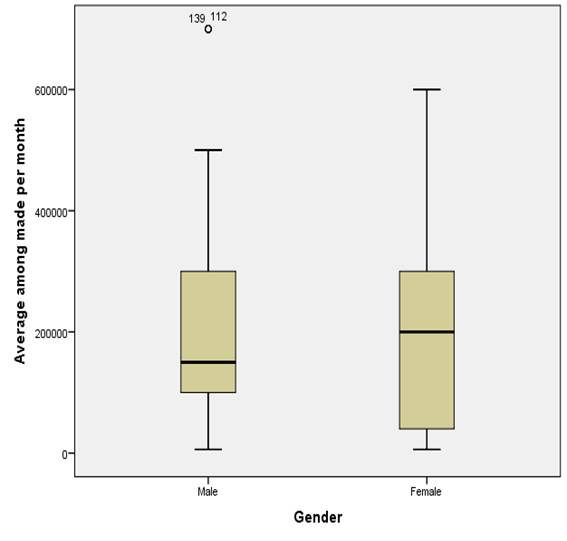
Overall, the average amount made from business per
month was 200143.79frs. The average amount made from the business per
months was 21096512frs for the male, slightly higher than that of the female,
with their average been 186253.73frs; but this difference was not statistically
significant (P=0.102).
Figure 8: Average amount made per months, comparing between male and female
But the median was higher for the female,
200000frs, as compared to 150000 frs for the male,
thus indicating that more female had business monthly income of 200000 frs or above than male. But male had the highest monthly
income but the standard deviations very similar indicate that male and female
had almost the level of variability in their monthly business income.
N=306
Figure 9: Perceived change in capital and number of employees
It was mostly perceived that capitals are fluctuation
69.0% (211), 21.9% (67) perceived an increase while 9.2% (28) perceived a
decrease.
Table 5: Perceived change in capital with respect to gender
Gender
Stats
Perceived change in
capital over the past 5 years
Total
Increase
Decrease
Fluctuating
Male
n
44
24
104
172
%
25.6%
14.0%
60.5%
100.0%
Female
n
23
4
107
134
%
17.2%
3.0%
79.9%
100.0%
Total
n
67
28
211
306
%
21.9%
9.2%
69.0%
100.0%
χ2-test: χ2=16.445; df=2; P=0.000.
More male perceived an increase in capital with proportion of 25.6%
(44), as compared to 17.2% (23) for female. At the same time, more male
perceived a decrease 14.0% (24) as compared to 3.0% (4) for female which more perceived
a fluctuation, with proportion of 79.9% (107), as compared to 60.5% (104) for
male.
As for the number of employers, it was generally fluctuating, 73.3%
(192), 18.3% (48) perceived an increase while 8.4% (22) perceived a decrease.
Table 6: Perceived change in the number of employees with respect to gender
Gender
Stats
Perceived change in the number of employees over the past five years
Total
Increase
Decrease
Fluctuating
Male
n
28
17
90
135
%
20.7%
12.6%
66.7%
100.0%
Female
n
20
5
102
127
%
15.7%
3.9%
80.3%
100.0%
Total
n
48
22
192
262
%
18.3%
8.4%
73.3%
100.0%
χ2-test: χ2=8.392; df=2; P=0.015.
Female perceived more fluctuation than male 80.3% (102) as compared to
66.7% (90) for the male. Male perceived an increase in the number of employees
over the past five years more than female, with proportion of 20.7% (28) as
against 15.7% (20) for the female. But at the same time, male perceived more
decrease, with proportion of 12.6% (17), as against 3.9% (5) for females.
Table 7: Correlation between variation in capital and number of employees
Spearman's rho
Perceived change in number of employees over the
past five years
Perceived change in capital over the
past 5 years
Correlation Coefficient
.829**
Sig. (2-tailed)
.000
N
262
**. Correlation is significant at the 0.01 level
(2-tailed).
There was a significant positive and very strong correlation between
change in capital and change in the number of employees (R=0.829; P=0.000).
This therefore implies that the more the capital, the more workers of the
informal sector employ.
Tax payment
Figure 10: Payment of tax by workers of the informal sector
N=306
A proportion of 12.4% (38) of workers of the informal sector pay taxes.
The type of tax ranged from business tax, insurance, liberal tax, VTA
license, and patent.
Table 8: Amount of tax paid per annum
Gender
N
Mean
Median
Minimum
Maximum
Std. Deviation
Male
16
158125.00
150000.00
10000
250000
63478.999
Female
19
128947.37
100000.00
30000
300000
104450.665
Total
35
142285.71
150000.00
10000
300000
88153.800
Mann-Whitney
U; U= 107.500; P=0.142.
In average, they pay 142285.71 frs of tax per years. Male tax was
relatively higher than that of the female, with an average of 150000 frs as compared to 100000 frs for
the female but this difference was not significant (P=0.142).
Table 9: Correlation between average amount made per
month and average amount of tax paid
Spearman's rho
Amount of tax paid per annum
Average among made per month
Correlation Coefficient
.624**
Sig. (2-tailed)
.000
N
35
**.
Correlation is significant at the 0.01 level (2-tailed).
There was a significant positive and strong correlation between average
amount made from the business per month and amount of tax paid per annum
(R=0.624; P=0.000). This therefore implies that the more the income, the more
the tax paid.
Only 12.1% (37) of workers of the informal sector had their business
registered.
The business was registered in the “registre de commerce”, taxation for some, council or UB campus for others.
Actors of the
informal sector make an average 776258.6 Frs
profit per year and a major share of this money is invested on their family,
both direct and extended for an average of 669721.62 frs for the direct family and 49379.39 frs
for their extended family, and save an average of 57157.58 frs.
Figure 122: Comparing
what informal sectors workers spend on extended family and their savings
Wilcoxon Signed Ranks Test (Z=-0.533; P=0.594).
Amount invested on extended family was the focus here because it was
assumed better standardized and discretional as compared to amount spent on
children, rent, electricity, health of one’s family which are determined by
parameters like family size, number of children, etc., which are not really
discretional, because you are more likely to spend more on education if you
have more children.
The amount invested on extended family was an average 49379.39 frs per years, not significantly
(P=0.594) different from the average 57157.58 frs
saved per year. This therefore implies that expenditure on extended family
absorbs a great share of profit.
Majority have re-invested in the business 54.7% (199) while 45.3% (165)
did not.
Majority of workers of the informal sector save from their business
52.6% (161) while 46.1% (141) did not save.
Those that did not save was generally because, it was not possible for
them to save 87.9% (124), 9.9% (14) as they invest
all on family charges and to sustain the business, while 5 making 3.5% gave
other reasons, settlement of business debts, lack of funds.
This trend did not differ significantly between male
and male.
There was a strong and significant positive correlation between amount
invested on family and the amount saved (R=0.503; P=0.000). This therefore
implies that more the investment on the family, the higher the savings. In the
other senses, family responsibility did not significantly hinder the
development of the informal sector, thus rejecting the hypothesis here stated.
How can the
Informal Sector be Transformed to Sustainably
Boost the Socio-Economic Development of the Actors and Cameroon at Large?
Informal workers expectations from government to
improve on the sector’ activities ranged from the need for training facilities,
grants/Sponsorship, tax reduction/tax incentive, loans, offering training,
education for all, improve on transport facilities, tax free in crises zones,
employment opportunities, tax free for beginners, provide farm input,
micro-loans, reduce training cost, create investment banks, trade union,
encouraging self-employment, create awareness, facilitate access to land,
friendly political atmosphere, improve on power supply, infrastructural
development, conducive business environment and control of inflation.
Informal workers expectations from the private sector
to improve on the sector’ activities ranged from salary increase, opening
training centres, payment of salary, in-service
training, organization of sector, good working condition, sponsorship/grants,
adequate power supply, objectivity, awareness of opportunities, respect for
employees, enterprise closer to source of raw materials, make fuel cheaper and
rent reduction.
Informal workers’ expectations from their peers to
improve on the sector’ activities ranged from collaboration,
innovative/creativity mind, organization/form association, honesty, business
promotion, adaptive, stable price, constant training, self-employment, create
awareness, proper management, family assistance, customer orientation, and
employment opportunities.
Focus
Group Discussion
Group discussions were organised
with relevant stakeholders to explore studied and informed opinion on the activities
of the informal sector and its impact on development. Discussions brought about
all actors of the informal sector. This involved tailors, petty vendors,
carpenters, car cleaners, builders, welders in all the three towns selected for
the study. This was deemed necessary as it provided an opportunity to collect
data that could not be easily captured by either questionnaire or interview. From the
discussion, wegathered the
following:
-Investing in the informal sector was more or
less conditioned by the economic situation of the country. Many are forced into
petty trading to put food on their table while waiting for better
opportunities. Most actors were school dropouts who had wanted to pursue their
education but for financial reasons they could not. Engaging in an informal
activity to many, at the initial stage was a temporary arrangement while
waiting and hoping for things to be normalised. It is only gradually that many
got into the web and leaving became difficult.
-The field of study did not matter. Many
embraced what in their opinion, could provide what they needed or what their
capital could afford. All levels of education was involved here, irrespective
of age.
-With their activities, many were able to feed
their families even if it wasn’t the three square meals every day.Many could provide a shelter for their close
ones as well as a minimum health care. Even though most resorted to
nonconventional medicine
-Their dwellings which very few owned, were
usually very precarious especially those living in Douala. Many live in very
filthy conditions and difficult neighbourhoods with very high crime rates.
-Most of them had spent more than ten years in
their activities which were quite varied. They all started like apprentices
then owned their own businesses after graduating from their mentors from whom
they received on-the-job training.
-Many never received formal education and did
not belong to a professional association thus were not constrained by any code
of ethics.
As understood by Tseng (1992) model that
powerful professions are controlled by powerful associations, most associations
organised by actors in the informal sector are more geared towards spicing the
social life of actors.
-A good number were not satisfied with their
remuneration. Many were ready to accept other jobs either from the government
of from any other employer. Even so, management of the resources they made from
the trade was another ball game. Most of the actors in this field lived from
hand to mouth. Very few though of ploughing back profit. The idea of making
constant money gave them the illusion that live will always be the same. They
most often consumed all what they made during the day with the hope that the
next day more shall come.
-The informal sector is plagued by a lot of
challenges: lack of capital to run the business, very little access to loan
especially from banks due to lack of collateral, lack of business registration,
thereby, no payment of taxes.
SUMMARY OF FINDINGS
Role of informal sector in the socio-economic development of the sector
and of Cameroon at large
Workers of the
informal sector were generally of the opinion that the informal sector employs
more than the formal sector (85.6%). They generally agreed (90.5%) that they
were remunerated and they dominantly fixed the remuneration cost themselves
(62.7%). The business organization was generally poor, as they mostly did not
belong to any trade union (99.0%), only 12.1% had the business registered, only
21.2% hold an expenditure book, less than majority had a bank account (40.5%),
and just 1.3% was registered in the stock market. They dominantly did not see
their present activity as permanent job (79.7%), which means they perceived it
more as a transitional phase to really achieve their vocation, thus aligning
with the 89.2% that were ready to accept an employment. Their monthly business
incomes range from 6000 to 700000 CFA, with the average at 200143.79 CFA.
Business growth was not satisfactory as just 21.9% perceived an increase in
capital over the years while 18.3% perceived an increase in the number of
employees. They generally did not pay tax as just 12.4% did so. They
contributed an average of 142258.71 CFA annually as tax to the government of
Cameroon. The contribution of the informal sector to the socio-economic
development was perceptible in various aspects. In average, workers of the
informal sectors had an average of 6 people under care, an average of 5 people
that they sponsored in school, spent an average of 372956.20
CFA on education per year, an average of 202140.29 CFA on health, 44365.57 CFA
on rent, 11945.66 CFA on water, 10361.02 CFA on electricity, 27952.88 CFA on
dressing, 49379.39 CFA on extended family. With respect to business
development, they have re-invested in average of 314386.94 CFA in their
business, an average of 57157.58 CFA was saved, and the average net profit was
776258.6 CFA. Majority had been able to save from their business (52.6%), while
majority as well had re-invested in the business (54.7%).
Measures to enhance the socio-economic benefit of the
informal sector
Measures to enhance the socio-economic benefit of the
informal sector were apprehended from government, the private sector, and
informal workers. Expectation from the government ranged from the need for
training facilities, grants/Sponsorship, tax reduction/tax incentive, loans,
offering training, education for all, improve on transport facilities, tax free
in crises zones, employment opportunities, tax free for beginners, provide farm
input, micro-loans, reduce training cost, create investment banks, trade union,
encouraging self-employment, create awareness, facilitate access to land,
friendly political atmosphere, improve on power supply, infrastructural
development, conducive business environment and control of inflation. Informal
workers expectations from the private sector to improve on the sector’
activities ranged from salary increase, opening training centres,
payment of salary, in-service training, organization of sector, good working
condition, sponsorship/grants, adequate power supply, objectivity, awareness of
opportunities, respect for employees, enterprise closer to source of raw
materials, make fuel cheaper and rent reduction. Informal workers expectations
from their peers to improve on the sector’ activities ranged from
collaboration, innovative/creativity mind, organization/form association,
honesty, business promotion, adaptive, stable price, constant training,
self-employment, create awareness, proper management, family assistance,
customer orientation, and employment opportunities. Reconciling expectations
from the government and the private sector, they had in common the need for
training centers, financial support, grants/non-refundable subsidies, tax
incentive for young companies, informing when are employment opportunities,
adequate power supply, providing good and favorable conditions for the workers
of the informal sector, and loans.
REFERENCES
Abbott. (1988) Dave Wield Development Studies Policy and
Practice the Open University Who Feeds the Urban Poor? The Indian
food-processing industry: an alienated ‘formal’ sector versus an attuned
‘informal’ sector by Dina Abbott DPP Working Paper No 35
Addison, T., Bhalotra, S.
and Heady, C. (1997). ‘Child Labour in Pakistan and
Ghana’, University of Warwick, Mimeo.
Becker (2004). Fact finding study The Informal Economy. Published by Sida
2004 Production: ORGUT Consulting AB Printed by EditaSverige AB, 200 Department for Infrastructure and
Economic Co-operation Bromley,
Ray, and Chris Gerry, eds. (1979). Casual
Work and Poverty in Third World Cities.Chichester, U.K.: Wiley.
Castells,
Manuel, and Alejandro Portes, (1989). World
Underneath: The Origins, Dynamics, and Effects of the Informal Economy. In The
Informal Economy: Studies in Advanced and Less Developed Countries, eds.
Alejandro Portes, Manuel Castells, and Lauren A.
Benton. Baltimore, MD: Johns Hopkins University Press.
Christina (1994).
The Informal Economy: Between New Developments and Old Regulations SaskiaSassen. The
Yale Law Journal Vol. 103, No. 8, Symposium: The Informal Economy (Jun., 1994),
pp. 2289-2304 (16 pages) Published By: The Yale Law Journal Company, Inc.
Djankov et al.(2003).
"Going Informal: Benefits and Costs" in BoyanBelev, editor. The Informal Economy in the EU
Accession Countries. Center for the Study of Democracy.
Freidson E. (2001) Professionalism, the third logic: on the
practice of knowledge: University of Chicago press; 2001
Gerxhani, Klarita (2001). The
Informal Sector in Developed and Less Developed Countries: A Literature
Survey‖, Public Choice, Vol. 120. Number 3
Hart, K.
(1973). Informal Income Opportunities and Urban Employment in Ghana, Journal of
Modern African Studies, Vol. 2.
Hart, Keith.
(1973). Informal Income Opportunities and Urban Employment in Ghana. Journal
of Modern African Studies 11 (1): 61–89
Hart, Keith.
(2004). Formal Bureaucracy and the Emergent Forms of the Informal Economy.
Paper presented at the EGDI-WIDER, United Nations University, conference
Unlocking Human Potential, September 17–18, 2004, Helsinki.
http://www.thememorybank.co.uk/papers/forms.
Henrick .( 2007)Labour Migration,
Integration Policy and The State. Malmö University 205 06 Malmö, Sweden WWW.MAH.SE
isbn 978-91-7104-730-4
(print) isbn 978-91-7104-731-1 (pdf)
ILO (2013).
Employment, Income and Equality: A Strategy for Increasing Productive
Employment in Kenya, International Labour Office,
Geneva.
ILO (1993).
ILO report of the Fifteenth International Conference of Labour
Statisticians, Geneva International Labour
Organization. 2002. Women and Men in the Informal Economy: A Statistical
Picture. Geneva: International Labour Office,
Employment Sector.
Moser, Caroline O.N. 1978. “Informal
Sector or Petty Commodity Production: Dualism or Dependence in Urban
Development?” World Development 6,
no. 9/10: 1041-1064.
OECD (2008)
"Employment Protection Regulation and Labour
Market Performance," In OECD Employment Outlook, pp. 61-125, OECD, Paris.
Portes, Alejandro, and John Walton. (1981). Labor, Class,
and the International System. New York: Academic Press.
Portes, Alejandro and SaskiaSassen-Koob.
1987. “Making it Underground: Comparative Material on the Informal Sector in
Western Market Economies.” American
Journal of Sociology 93, no. 1: 30-61.
Portes, Alejandro (1994). When More Can Be Less: Labor
Standards, Development, and the Informal Economy. IN Contrapunto:
The Informal Sector Debate in Latin America, Cathy A. Rakowski
(ed.). Albany: State University of New York Press, pp.
113-130
Schneider et al. (2001), «Women’s economy between
subsistence and market production in Harare, Zimbabwe», B. Wohlmuth
et al. (eds.), Africa’s
Integration into the World Economy, Hamburg, LIT Verlag, pp. 731‑764.
Schneider,
F. (2002). "Size and Measurement of the Informal Economy in 110 Countries around
the World", Paper presented at the Workshop of Australian National Tax
Centre, ANU, Canberra, Australia, July 17.
Smith.
(1987). Measuring the Informal Economy. Volume 493 Issue 1, September 1987
The World Bank. 2015b. “The Growth Challenge: Can
Ugandan Cities Get to Work?” Uganda Economic Update, Fifth Edition, The World Bank Group (February).
Tseng, J. (1992),
Interpreting as an Emerging Profession in Taiwan. A Sociological Model,
unpublished Master’s Thesis, Fu Jen Catholic University, Taiwan.
Wilensky.(1964). The Professionalization of Everyone? American Journal
of Sociology Vol. 70, No. 2 (Sep., 1964), pp. 137-158 (22 pages) Published By:
The University of Chicago Press.
Cite this Article:Kindeh, S
(2024). The Professionalization of the Informal Sector for Effective
Socioeconomic Development.Greener Journal of Social Sciences, 14(1): 68-84.